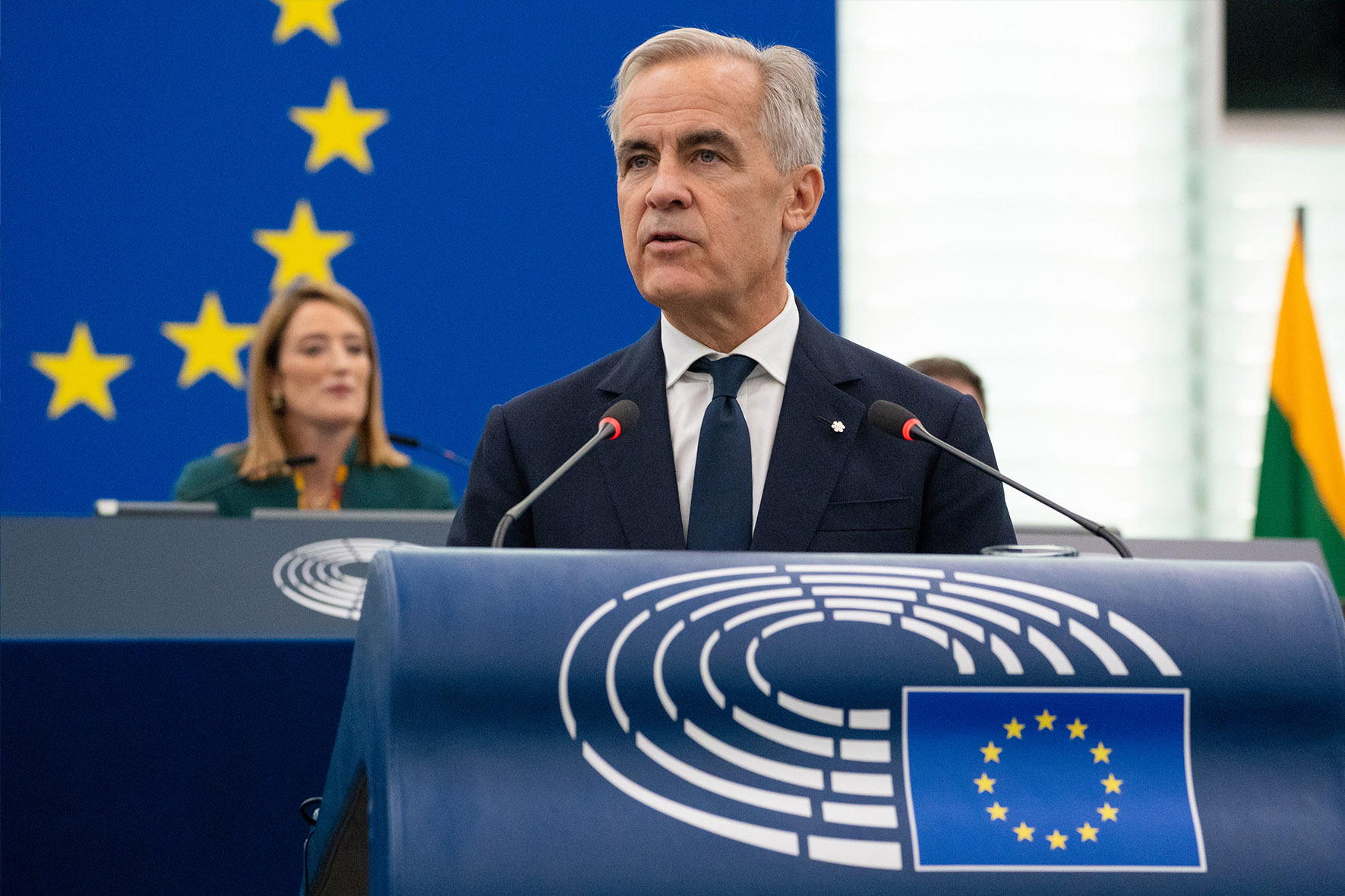
Canada is the most European of the Americas. Canada is Europe in America, but if its Prime Minister accepted, last Thursday, the status of ‘associate member’ of the Union offered to him by the President of the Commission, it is above all because we must present a united front.
It hasn’t been stated as such, but a political alliance has indeed just been forged – an alliance against a man whose name Mark Carney never mentioned, against the American adversary who would like to annex Canada, has his eye on Greenland and is trying to force us all to bow to his will through customs tariffs.
Donald Trump found this ‘laughable’, but he would do well to open his eyes and see that this partnership between Canada and the European Union was already taking shape in the rapprochement between the EU, the UK and Norway; in the Coalition of the Willing formed by Paris and London to support Ukraine, or indeed in the European Political Community envisaged by Emmanuel Macron as early as 2022 to bring together all European democracies, whether or not they are members of the EU, within a single forum.
Feeling its way, the European Union has for several years now been seeking to counter Russian expansionism, Chinese dumping and the US’s withdrawal by fostering a global network of democracies keen to stand united against these three threats. With a strong global presence and boasting the finest armies in Europe, France and the United Kingdom are at the helm, and it is striking that it is precisely with a country in which both nations wield such considerable influence that matters have now gathered pace.
The status of ‘associated member’ remains to be defined. It will not necessarily be straightforward, but the European constellation now adds a fourth category of states to the Member States, candidate countries and those wishing to become candidates, of which Canada is merely the vanguard. As ‘associates’ rather than members, Australia, South Korea, New Zealand, perhaps one day Japan, Turkey, once it has broken with its drift towards autocracy, as well as states from Africa and the Middle East, would thus be well placed to forge closer ties with the European Union within what is already being called the Alliance of the Future and which I, for my part, propose to call the Democratic Entente.
‘That remains to be seen,’ some might say. ‘Utopia,’ said many Europeans following the speeches by Ursula von der Leyen and Marc Carney – but that overlooks the fact that, until very recently, very few believed the Union would move towards a common defence, would arm Ukraine, would consider the idea of a ‘European preference’ to counter China, would come to accept the possibility of common industrial policies, and would seek to establish a Security Council.
In politics, necessity is the mother of invention. Canada is proof of this, but the real question is whether we Europeans will rise to the challenge. A growing part of the world would like us to assert ourselves so that they can assert themselves alongside us, but the Union itself risks falling apart if our votes hand power to the far right in several of our major capitals.
In France, as in Germany, we are not far from fulfilling the shared dream of Trump and Putin, and even if we were to abandon this suicidal course, our common institutions risk soon paralysing us. Designed for a common market, they grant the Union neither genuine executive power nor genuine legislative power, thereby preventing it from fully transforming itself into a political power.
This is so true that when Ursula von der Leyen, in Strasbourg, reached out to Canada or launched her European Security Council, she was overstepping the powers granted to a Commission President. Because the treaties no longer meet today’s needs, she effectively violated them to create fait accomplis – welcome and necessary ones.
Photo : © European Union 2026 – EP