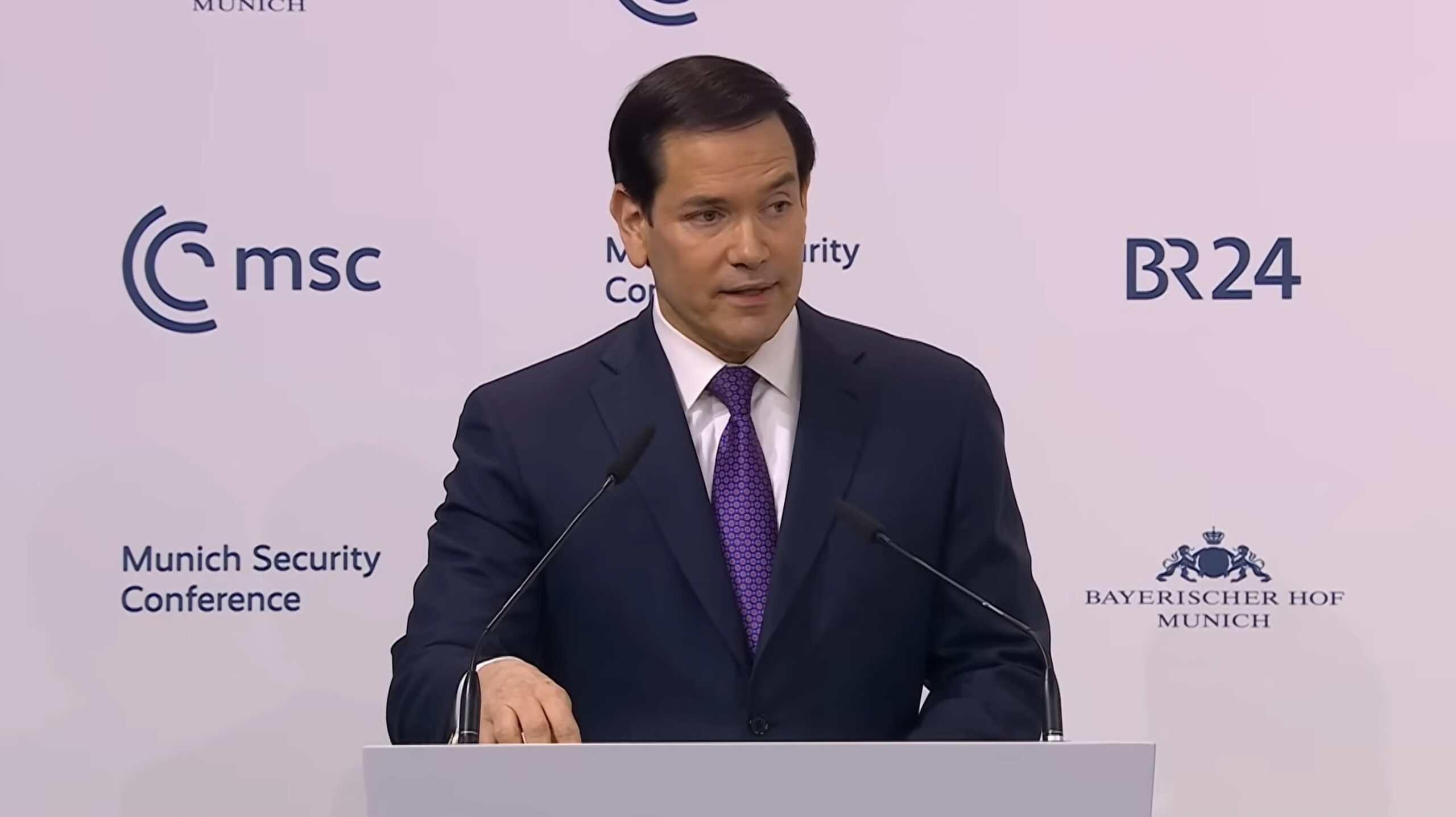
The tune has changed. This time, Donald Trump sent his Secretary of State Marco Rubio to Munich, a man polite enough to say that the United States was Europe’s child, that it wanted Europe to be strong and wanted to ‘revitalise’ the Atlantic Alliance rather than break it up. But why had the American president changed tack?
It wasn’t that he had changed his mind. Donald Trump had not given up on dismantling the European Union, but he had learned from the failure of his vice-president twelve months earlier, when he had attacked the Europeans head-on at the same security conference.
At the time, all J.D. Vance achieved with his speech was to close the ranks of the Union. He had suddenly created such a rift between the two sides of the Atlantic that a large majority of Europeans no longer consider America to be their ally. He had thus put the far right, on which America intends to rely, in an awkward position, and that’s not all.
Then, by trying to force Ukraine to surrender and threatening to annex Greenland, Donald Trump brought the EU, the UK, Canada and several other democracies together in a united front, forcing him to back down twice.
More rounded and less hostile to democracy than J.D. Vance or Elon Musk, Marco Rubio was in a position to reach out to Europe, but where did he go after Munich?
To the only two countries in the EU, Hungary and Slovakia, which, like Donald Trump, would like Ukraine to accept Russia’s conditions for a ceasefire. Fundamentally, nothing has changed, but why, secondly, did Europeans applaud Marco Rubio so enthusiastically when he had so clearly urged them to rally behind the MAGA dogma?
Again, the reason is simple. They were relieved to see the White House swap a frontal attack for an acknowledgement of disagreement between allies. This will not make things any easier for them. On the contrary, the far right will find room for manoeuvre. Marco Rubio’s courtesy could prove to be much more effective for Donald Trump than J.D. Vance’s brutality had been, but by forcing the White House into this tactical change, the Europeans have gained time.
Now that the United States has sought to reinvigorate it, it will be less likely to leave the Atlantic Alliance overnight and thereby close its nuclear umbrella. Europe will be fewer steps away from finding itself without American protection before it has been able to develop its own defence. Thanks to their resistance to Trump’s offensive, the Europeans have given themselves the breathing space needed to reach the compromises without which the Union will not be able to reinvent itself as a political power.
For the time being, everything is in flux. There is constant debate everywhere about the terms of gradual enlargement, enhanced cooperation, the extension of French deterrence to other EU countries, the establishment of a European Security Council with a seat for the United Kingdom, and the future of the Atlantic Alliance, which Emmanuel Macron visibly does not believe in, while the Germans would like to rebuild it on two pillars, European and American.
There are clear differences of opinion among European partners, but these do not constitute real divergences, as their unanimity on the essentials was striking in Munich.
Including the British, they all share the same desire to be able to defend themselves as quickly as possible and a refusal to let Trump redraw the borders of Europe. As for the sustainability of the Alliance, they all know that ultimately it will depend on the United States and not on them, and that in the meantime, their task is to work on their common defence.
Photo: US Department of State